On this page11 sections
Your truck works every hour your tech works, but the invoice only shows labor and parts. The payment, the insurance, the tags, the fuel and the tires still have to come out of the hours you bill, and most of those costs arrive whether the truck moves or not.
This guide puts a number on it: what one service truck costs per year, per mile and per billable hour. It works through the site's example truck line by line, so you can swap in your own figures as you go.
Why the truck belongs in your hourly rate
The hourly rate you charge has to carry everything that keeps a tech in the field: loaded labor, overhead, the truck and profit. If the truck is left out, every billable hour pays for it out of profit without anyone noticing.
In the site's example shop, the truck adds $13.74 to a break-even rate of $112.68, about 12% of it. At a 10% net profit on price, the rate with the truck is $125.20; set the truck line to zero and it drops to $109.93. That $15.27 gap is what the truck needs from every billable hour once profit is included. The full build-up of that rate is in how to calculate your labor rate.
Some shops carry trucks inside overhead instead of as a separate line. That works as long as the truck is counted once. If the truck payments are already in your overhead figure, don't add a truck line on top.
When every tech has a truck, both methods land in the same place. The example shop's three trucks cost 3 × $16,719.14 = $50,157.42 a year. Added to its $120,000 of example overhead, that is $170,157.42 spread over 3 × 1,216.8 = 3,650.4 billable hours, or $46.61 an hour, which is the same as $32.87 of overhead plus $13.74 of truck. The separate line simply keeps the truck visible, and it lets you price a tech whose truck costs more or less than the others.
Ownership costs and operating costs
AAA's yearly Your Driving Costs study splits a vehicle's cost into two groups, and the split works for a service truck too (AAA, 2026).
Ownership costs come due whether the truck runs 5,000 miles a year or 25,000:
- Depreciation: the difference between what you paid and what the truck will sell for, spread over the years you keep it. AAA calls it the single largest ownership cost (AAA Newsroom).
- Finance charges: the interest on the loan. Our calculator counts only the interest, because the principal you repay is the purchase price, and depreciation already spreads that over the years.
- Insurance.
- License, registration and taxes.
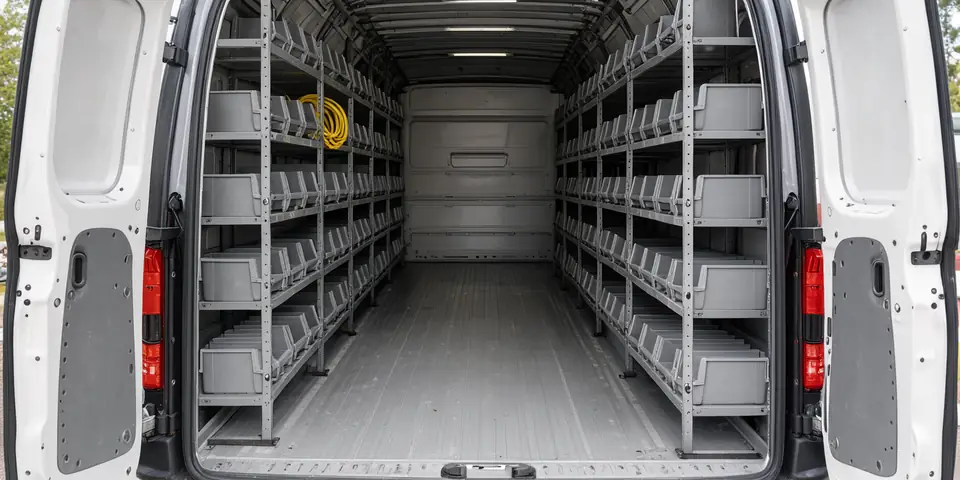
- Other fixed costs that AAA doesn't price: shelving, racks and bins spread over the truck's life, GPS tracking, a parking space.
If you lease, the yearly lease payments take the place of depreciation and finance charges.
Operating costs rise with every mile:
- Fuel: price per gallon ÷ miles per gallon.
- Maintenance, repairs and tires, per mile.
The split matters later. Ownership costs belong in the hourly rate, and only the operating cost per mile is a fair basis for a distance charge.
The example truck, line by line
The site's example truck uses AAA's 2026 figures for a half-ton pickup, which are averages for five top-selling 2026 models AAA selected, at AAA's base case of 15,000 miles a year. Fuel is priced at $4.465 a gallon, the U.S. average retail price of regular gasoline for Monday, September 28, 2026 (EIA). EIA collects its retail prices every Monday (EIA definitions).
AAA doesn't print a miles-per-gallon figure. It priced gasoline at $4.152 and put the pickup's fuel cost at 23.87¢ a mile, which implies about 17.4 mpg (4.152 ÷ 0.2387 = 17.39). The example uses 17.4 mpg.
| Line | Per year | Per mile | Per billable hour | Where it comes from |
|---|---|---|---|---|
| Depreciation | $6,248.00 | 41.65¢ | $5.13 | AAA 2026, half-ton pickup |
| Finance charges | $1,637.00 | 10.91¢ | $1.35 | AAA 2026 |
| Full-coverage insurance | $2,134.00 | 14.23¢ | $1.75 | AAA 2026 |
| License, registration, taxes | $1,078.00 | 7.19¢ | $0.89 | AAA 2026 |
| Ownership subtotal | $11,097.00 | 73.98¢ | $9.12 | Sum |
| Fuel ($4.465 ÷ 17.4 mpg) | $3,849.14 | 25.66¢ | $3.16 | EIA price, mpg implied by AAA |
| Maintenance, repairs, tires | $1,773.00 | 11.82¢ | $1.46 | AAA 2026 |
| Operating subtotal | $5,622.14 | 37.48¢ | $4.62 | Sum |
| Total | $16,719.14 | $1.1146 | $13.74 | Sum |
The per-billable-hour column divides each yearly figure by 1,216.8 billable hours, explained in the next section. Ownership costs are 66.4% of the total, which is why a truck that sits still for a week still costs you.
- Depreciation$6,248.00
- Finance charges$1,637.00
- Insurance$2,134.00
- License, registration, taxes$1,078.00
- Fuel15,000 mi ÷ 17.4 mpg × $4.465$3,849.14
- Maintenance, repair, tires15,000 mi × 11.82¢$1,773.00
- Cost a year$16,719.14
AAA's own total for the same vehicle is $16,449 a year, or $1.0966 a mile, and its headline puts half-ton pickups at $1.10 a mile. The example comes out $270.14 higher: the newer fuel price adds $268.64 over 15,000 miles, AAA's four ownership lines add up to $11,097 while its table prints $11,096, and AAA's printed total is 50¢ below its own lines added up ($11,096 + 15,000 × 35.69¢ = $16,449.50).
These are figures for the new pickups AAA studied. Nothing in them prices shelving, ladder racks, bins or tools, and AAA doesn't say its insurance line reflects a commercial auto policy. Replace each line with your own: the depreciation you expect, the interest on your loan, the premium on your declarations page, your registration bill, and your fuel and repair records.
Which hours to divide by
The same yearly cost gives three different hourly numbers, depending on what you divide by:
- Per hour in use: $16,719.14 ÷ 1,872 worked hours = $8.93. Useful for comparing trucks, not for pricing.
- Per paid hour: $16,719.14 ÷ 2,080 = $8.04. This one understates the cost of every hour you sell by $5.70.
- Per billable hour: $16,719.14 ÷ 1,216.8 = $13.74. This is the number that goes into your rate, because only billable hours bring in money.
The example shop's 1,216.8 billable hours come from 2,080 paid hours, minus 208 hours of paid time off, times 65% billable efficiency. That 65% is the only measured figure the site found. It comes from Field Promax, a field service software company, which reported it from more than 10,000 data points across 300 HVAC companies (ACHR News, June 16, 2026). Field Promax measured it against paid time; our calculator applies it to worked hours, which gives fewer billable hours and a higher cost per billable hour. ServiceTitan's labor rate calculator, which counts only sold hours, calls 30% a good rate. The range is wide, so measure your own.
Efficiency moves the truck cost a lot. The same truck costs $17.86 per billable hour at 50% efficiency (936 hours) and $11.91 at 75% (1,404 hours). The billable efficiency guide covers how to measure yours.
Divide by the billable hours of the tech who drives that truck. A spare truck with no regular driver has no billable hours of its own; its cost belongs in overhead, where it spreads across every tech.
What moves the number
Miles. More miles raise the yearly cost but lower the cost per mile, because the ownership costs spread thinner. Here is the example truck with depreciation held at $6,248:
| Miles per year | Yearly cost | Per mile | Per billable hour |
|---|---|---|---|
| 10,000 | $14,845.09 | $1.4845 | $12.20 |
| 15,000 | $16,719.14 | $1.1146 | $13.74 |
| 20,000 | $18,593.18 | $0.9297 | $15.28 |
| 25,000 | $20,467.23 | $0.8187 | $16.82 |
In reality, depreciation also climbs with mileage. AAA lowers it by $513 a year at 10,000 miles and raises it by $592 at 20,000 (both averaged over five years). Our calculator keeps depreciation as you enter it, so a high-mileage truck needs a higher depreciation figure from you.
Fuel. At 17.4 mpg, every $1 a gallon adds 5.75¢ a mile. Over 15,000 miles that is $862.07 a year, or $0.71 per billable hour. EIA publishes the national average every week, so date the price you use and update it when it moves.
Upfit. Shelving, racks and bins are a real ownership cost that AAA doesn't include. As an example, $6,000 of upfit spread over five years adds $1,200 a year, or $0.99 per billable hour, bringing the example truck to $14.73.
Insurance. If your truck is on a commercial policy, use that premium. The site has no source for a typical commercial auto premium, so there is no default for it.
Personal use. If the truck also does personal driving, only the business share belongs in your rate. As an example, if 12,000 of 15,000 miles are for work, that is 80%: $13,375.31 of the example truck's yearly cost, or $10.99 per billable hour. A mileage log gives you the split. How the IRS treats a mixed-use vehicle is a separate question for your accountant.
How to work out your own truck's cost per billable hour
- Gather last year's records for one truck: the lender's interest statement, the insurance premium for that vehicle, the registration and tax bills, fuel card totals, repair and tire invoices, and odometer readings at the start and end of the year.
- Estimate depreciation: (purchase price − expected resale value) ÷ years you'll keep it. AAA's $6,248 matches, for example, a $55,000 truck sold for $23,760 after five years. If you lease, use the yearly lease payments instead and skip depreciation and finance charges.
- Add the ownership costs: depreciation, interest, insurance, license, registration and taxes, plus upfit spread over its life, GPS and parking.
- Work out the operating cost per mile: fuel price ÷ your mpg, plus maintenance, repairs and tires ÷ miles driven. If you have a full year of fuel receipts, fuel spend ÷ miles is more accurate than a price and an mpg.
- Find the yearly cost: ownership costs + operating cost per mile × miles per year.
- Find the billable hours of the tech who drives it: hours actually invoiced over the last 12 months, or worked hours × your billable efficiency.
- Divide: yearly cost ÷ billable hours. That is the truck line in your hourly rate.
- Write down the operating cost per mile separately. You need it for trip charges (see below).
- Redo it once a year, and sooner if fuel prices move by a dollar or more a gallon.
The IRS mileage rate as a cross-check
The IRS business standard mileage rate is 72.5¢ a mile for January 1 through June 30, 2026, and 76¢ a mile from July 1 through December 31, 2026 (IRS). The midyear rise came in Announcement 2026-11, published July 13, 2026, which modified Notice 2026-10 and said the change was due to recent fuel price increases (IRB 2026-29). The 2025 rate was 70¢.
The IRS sets the rate from a yearly study, run by an independent contractor, of the fixed and variable costs of operating an automobile (Notice 2026-10). It is a single rate per business mile, so it can't reflect your truck's price, your insurance or your mileage.
On the example truck's 15,000 miles:
- All at 72.5¢: $10,875, about 65% of the computed $16,719.14.
- 7,000 miles from January through June at 72.5¢ ($5,075) plus 8,000 miles from July through December at 76¢ ($6,080): $11,155, about 66.7%.
- All at 76¢: $11,400, about 68.2%.
The IRS also states how much of each business mile counts as depreciation: 35¢ for 2026. AAA's half-ton pickup depreciation works out to 41.65¢ a mile ($6,248 ÷ 15,000).
So the IRS rate sits well below the cost of a new half-ton pickup in AAA's figures. If your own cost per mile comes out below the IRS rate, check that depreciation and insurance made it in.
The rate also comes with rules. For a vehicle you own, you have to choose it in the first year the vehicle is available for use in the business, and you can't use it if you operate five or more vehicles at the same time (IRS Topic 510). Business parking and tolls are deductible separately under either method. This is general information, not tax advice; ask your accountant which method fits your trucks.
In the rate or as a trip charge?
Ownership costs go in the hourly rate. They are there whether the truck drives one mile or a hundred, and the hours you bill are what pay them. In the example that is $9.12 of the $13.74 per billable hour.
Operating costs can follow the miles. The example truck's operating cost is 37.48¢ a mile. That is the fair basis for an extra distance or zone charge on long trips, because it is the part of the truck's cost that the extra miles actually create.
Charge each cost once. If the truck is in your rate, a trip charge shouldn't use the full $1.1146 a mile, because that would collect the ownership costs a second time. On a 24-mile round trip, the operating cost is $9.00; the full cost is $26.75. Use the full cost per mile only if your hourly rate leaves the truck out.
Drive time is a separate question. Either you bill it through a service-call fee and count those hours as billable, or you leave it unbilled and the billable efficiency in your rate absorbs it. The Field Promax data counted about 1.13 hours a day of driving that wasn't recovered through trip charges. How to set a service call fee works through that choice.
Mistakes that double-count or hide truck cost
- Counting the full loan payment and depreciation. The principal is the purchase price, and depreciation already covers it. Count interest only.
- Carrying the truck in overhead and in a truck line. Pick one.
- Using the IRS rate as your cost. On the example truck it covers about two-thirds of the computed cost.
- Dividing by 2,080 hours. That gives $8.04 instead of $13.74, and the missing $5.70 an hour comes out of profit.
- Using AAA's pickup figures for a cargo van or box truck. The pickup categories don't describe those vehicles; use your own records.
- Leaving fuel at an old price. AAA's study priced gasoline at $4.152; the EIA average price for Monday, September 28, 2026 was $4.465, a gap worth $268.64 a year on the example truck. Date the price you use.
Next step
Open the truck cost calculator. It starts with the example truck above; replace each line with your own records, then carry its cost per billable hour into the truck line of the labor rate calculator.
Sources
- Standard mileage rates
- Internal Revenue Bulletin: 2026-29 (Announcement 2026-11)
- Notice 2026-10, 2026 Standard Mileage Rates
- Topic no. 510, Business use of car
- Your Driving Costs 2026 (brochure)
- AAA: New Vehicle Ownership Costs Hit $12,863 Annually
- Gasoline and Diesel Fuel Update
- Report: Only 65% of HVAC Technician Time is Billable Hours
Tools for the job
Tool listCross-trade4 itemsSpecs read
As an Amazon Associate, Trade Price Book earns from qualifying purchases. Amazon links are marked “(paid link)”; prices aren’t shown here.
Cordless drill and driver kitsMilwaukee 3697-22
M18 FUEL 2-Tool Combo Kit
- M18 FUEL 1/2 in. hammer drill/driver (2904-20) and M18 FUEL 1/4 in. hex impact driver (2953-20).
Specs: Milwaukee product page, read
Search on Amazon for Milwaukee 3697-22(paid link)
Cordless drill and driver kitsDEWALT DCK2101QQ2
20V MAX XR 3-Speed Hammer Drill & Impact 2-Tool Combo Kit
- DCD1007 1/2 in. 3-speed hammer drill rated at 2,100 in-lb of max torque.
Specs: DEWALT product page, read
View on Amazon for DEWALT DCK2101QQ2(paid link)
Job-site and van storageMilwaukee 48-22-8426
PACKOUT Rolling Tool Box
- 250 lb weight capacity; IP65 weather seal.
Specs: Milwaukee product page, read
View on Amazon for Milwaukee 48-22-8426(paid link)
Job-site and van storageVeto Pro Pac Tech Pac MC
Tech Pac MC Backpack Tool Bag
- 16 x 12 x 9 in. backpack; 8 lb empty, 35 lb maximum payload (Veto part VPP10066).
Specs: Veto Pro Pac product page, read
Newsletter
At most one e-mail a day, only about new guides and tools. No tracking pixels. How we handle your address